
It's Jump Time!
a Tribute to the mystic known as Dr. Jean Houston

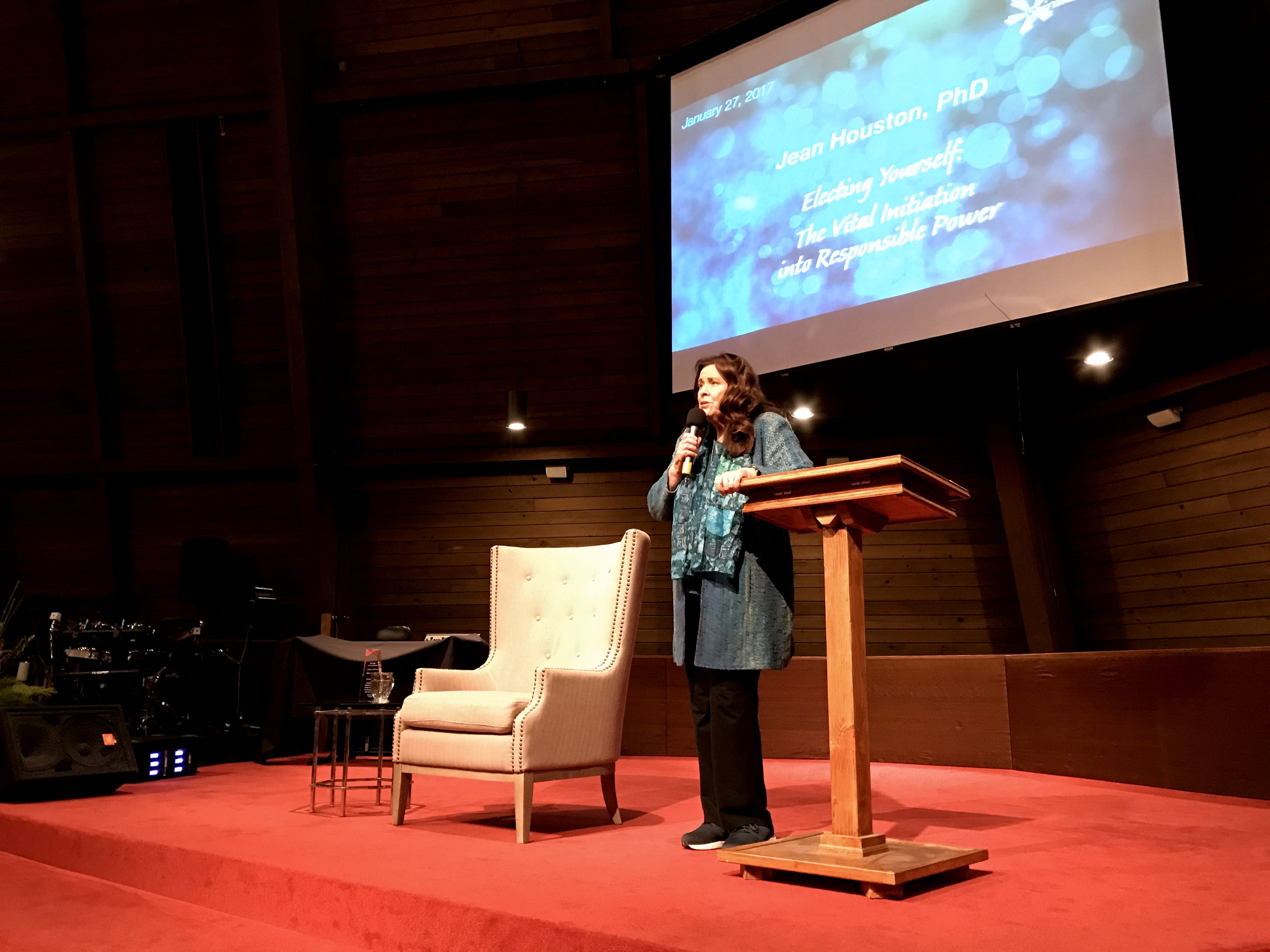
There are certain people who come along and shape the spiritual imagination of generations.
Jean Houston was one of those people. She lived at the edge of the cosmos and carried us all with her in her story telling and prophetic urging to awaken our untapped potential.
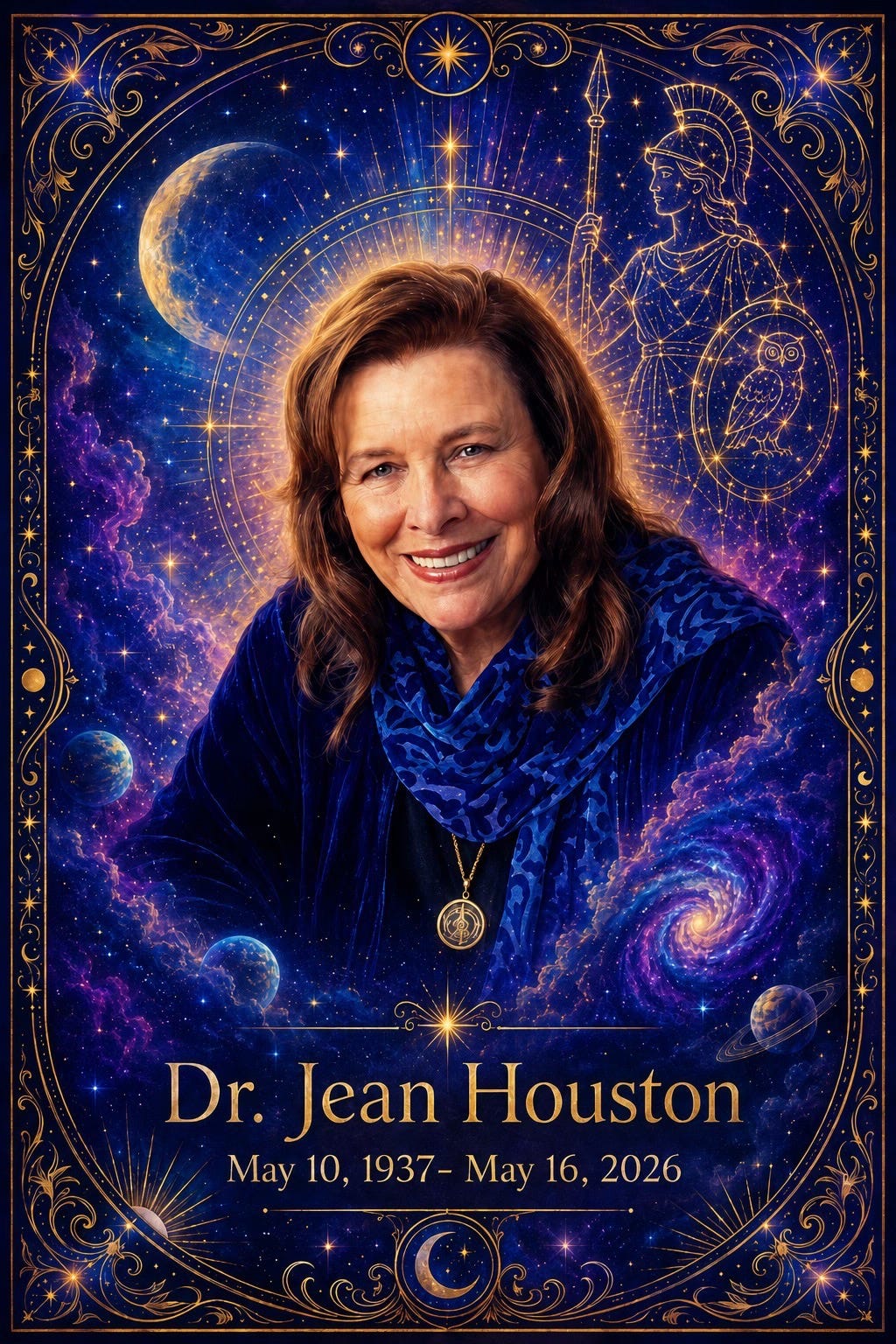
A mighty oak in the Human Potential and Spiritual movement known as New Thought. She was a researcher, educator, mystic, teacher and pioneer. She left this plan of existence May 16, 2026 after 89 years of extraordinary life experiences and contributions. As word spread of her passing there was some confusion online, folks unable to confirm through google or news sources and thus speculation hung in the air. I found that quite fitting, because when we think of Jean Houston and her impact, it is bigger than life and of cosmic proportions.
Many today may not immediately recognize her name, yet they are living downstream from her influence nonetheless. Long before conversations about consciousness became mainstream podcast material, before mindfulness became corporate vocabulary, before “human flourishing” became a research category, before the language of transformation, shadow work, embodiment, archetypes, and awakening saturated spiritual culture, Jean Houston was already asking unsettling and expansive questions about what it means to be human and pioneering each of these areas well ahead of just about anyone.
Her quest was to awaken humanity to its full potential. When you heard her speak, or even just read her books - one was captured by her passion and desire for each person to become their fully realized self.
Not merely successful.
Not merely productive.
Not merely informed.
But fully human.
And that distinction matters now more than ever.
“The essential drama of our time is the awakening of humanity to itself.” - Jean Houston
Because we are living through a moment in history where humanity possesses astonishing technological power while simultaneously appearing spiritually exhausted, morally fragmented, emotionally overwhelmed, and increasingly unable to imagine a shared future. We have access to limitless information and yet seem to suffer from a profound crisis of wisdom. We are hyperconnected digitally while becoming disconnected psychologically, spiritually, and communally. Our culture can engineer artificial intelligence, manipulate genomes, and launch billionaires into space, yet often struggles to cultivate empathy, moral courage, collective responsibility, or even sustained attention.
One only need look at the daily headlines of political tensions, gross incompetence and misguided personalities, all of which has been empowered to some degree by our electoral process, to see that we suffer from a profound lack of imagination.
Jean Houston spent much of her life warning us, in her own way, that civilizations do not collapse merely because they lack technology or intelligence. They collapse because they lose access to imagination, meaning, mythic depth, and the larger capacities of the human spirit. The capacity to see and feel a better future and let it live in us was her constant urging.
And in many ways, her life’s work became an argument against reductionism itself.
Against the reduction of human beings into consumers.
Against the reduction of consciousness into chemistry alone.
Against the reduction of spirituality into dogma.
Against the reduction of education into information transfer.
Against the reduction of society into competition and survival.
“We are all possessed by extraordinary powers and capacities that are not being used.” - Jean Houston
She insisted that human beings contain far more possibility than modern industrial culture has trained us to believe.
That idea may sound almost obvious now within spiritual and transformational circles today, but it was far more radical when Houston first began exploring these themes in the middle of the twentieth century.
Born in 1937, Houston emerged within a generation deeply shaped by the trauma of world war, nuclear fear, ideological conflict, and the existential anxieties of modernity. The horrors of the twentieth century forced many thinkers to wrestle with a difficult question: if humanity could produce Auschwitz, Hiroshima, segregation, colonialism, and mechanized violence on such an unimaginable scale, then what exactly had gone wrong in human consciousness?
Some responded politically.
Some psychologically.
Some theologically.
Some philosophically.
Houston approached the question through the lens of human potential, mythic imagination, spirituality, creativity, and consciousness itself.
Her work intersected with some of the most important intellectual and spiritual currents of the twentieth century. She moved within circles influenced by anthropology, psychology, mysticism, mythology, contemplative practice, and systems thinking. She collaborated with thinkers like Robert Masters (her husband) and was deeply influenced by relationships with figures such as Margaret Mead. Her work existed within the broader ecosystem that included names like Carl Jung, Abraham Maslow, Joseph Campbell, and Pierre Teilhard de Chardin (whom she met in her teens while walking through Central Park, they sparked a friendship that changed the world) — all thinkers attempting to reclaim dimensions of humanity that modernity had neglected or fragmented.
Yet Houston’s voice remained uniquely her own.
Where some thinkers became trapped in academic abstraction, Houston remained deeply experiential. She believed transformation was not merely conceptual. Human beings do not awaken, she argued, simply because they acquire new information. They awaken through encounter, imagination, practice, relationship, ritual, story, embodiment, and expanded participation in life itself.
This became one of the defining characteristics of her work.
She understood that wisdom is not merely knowledge. Wisdom changes the structure of perception.
And perhaps that is why her work resonated so deeply with seekers across spiritual traditions. Houston carried a kind of mythic intelligence that understood human beings not merely as isolated individuals, but as participants in larger symbolic, archetypal, historical, and evolutionary realities.
Her landmark work, The Possible Human, challenged the prevailing assumption that humanity had already reached the limits of its development. Instead, Houston proposed that most people live using only a fraction of their emotional, creative, moral, intuitive, and spiritual capacities. Human beings, she believed, are profoundly underdeveloped relative to what they might yet become.
That idea can easily drift into self-help cliché today, but Houston meant something far deeper than personal optimization. She was not merely talking about becoming more efficient, more productive, or more successful.
She was talking about the evolution of consciousness itself.
And importantly, she increasingly came to understand that such evolution could not remain solely individualistic.
Like much of the broader Human Potential Movement, early consciousness culture sometimes struggled with excessive individualism. At times, parts of the movement drifted toward spiritual consumerism, elitism, or forms of transcendence that insufficiently engaged systems of injustice, inequality, and collective suffering. Some expressions of New Age spirituality became detached from history, politics, economics, race, or social responsibility altogether.
Any spirituality that focuses only on inner peace while ignoring structural suffering eventually becomes incapable of confronting reality honestly.
But Houston’s work evolved beyond much of that limitation.
Over time, she increasingly emphasized what she called “social artistry” — the idea that human transformation must ultimately express itself collectively, creatively, and socially. Consciousness was not merely about personal enlightenment. It was about participating in the healing and evolution of humanity itself.
We are currently living through what appears to be not only a political crisis, but a crisis of imagination and becoming.
We see technological advancement without moral maturity.
Information without wisdom.
Visibility without depth.
Reaction without reflection.
Identity without community.
Power without initiation.
And underneath much of our collective anxiety sits a haunting question:
What kind of human beings are we becoming?
That is not merely a political question.
It is not merely a theological question.
It is not merely a psychological question.
It is a civilizational question.
Jean Houston understood this long before many others did.
She recognized that societies are shaped not only by laws and economies, but by stories, symbols, myths, rituals, archetypes, and the collective imagination.
She taught us that, human beings live according to the realities they are capable of imagining. When imagination collapses into fear, domination, scarcity, tribalism, or nihilism, societies begin reproducing those realities outwardly.
But when imagination expands toward compassion, creativity, dignity, interconnectedness, and possibility, entirely new futures become conceivable.
This is one reason her work matters now as much as it ever did. Because she refused to accept the impoverished view of humanity that modern culture so often hands us.
She believed there was more within us.
More moral capacity.
More spiritual depth.
More creativity.
More courage.
More compassion.
More imagination.
More becoming.
One of the great misunderstandings of modern spirituality is the assumption that wisdom is simply information one acquires individually.
Houston never taught that way.
Like many of the great mythic and transformational teachers, she understood wisdom as something transmitted through encounter, practice, story, relationship, and lived formation. Her work carried echoes of what many traditions would recognize as mystery school consciousness — not secret in the sensational sense, but initiatory in the sense that human beings awaken layer by layer into deeper dimensions of themselves and reality.
That lineage continues today through many teachers and practitioners shaped by her work.
One of those is my friend Rev. Elisha Christopher Hayden, who studied and mentored with Houston for many years and continues carrying aspects of that mythic and transformational framework into his own ministry and teaching through Centers for Spiritual Living Santa Cruz and his unique work called the Synthesis Collective.
What I appreciate about that continuity is that it reminds us spirituality is not merely about collecting concepts or consuming inspiration. It is about formation. About becoming. About awakening dimensions of ourselves that modern systems often suppress, flatten, or leave dormant.
And perhaps that was always Jean Houston’s deeper question beneath all the workshops, writings, lectures, and explorations:
What hidden possibilities still live inside the human soul?
Not merely waiting to be admired.
Not merely waiting to be theorized about.
But waiting to be practiced into being.
That question remains profoundly relevant.
Especially now.
Because the future may ultimately depend less on whether humanity becomes more technologically advanced and more on whether humanity becomes more deeply human.
Jean Houston believed humanity was still unfinished. That beneath our violence, fragmentation, fear, and systems of domination lived capacities we had scarcely begun to cultivate. She believed imagination mattered because futures are first born there. She believed consciousness mattered because societies eventually become reflections of the inner worlds they normalize. And perhaps most importantly, she believed that spiritual awakening was never merely personal escape, but participation in the ongoing evolution of humanity itself.
“The essential drama of our time,” she wrote, “is the awakening of humanity to itself.”
It is difficult to imagine a more necessary task for the world we now inhabit.
Resources:
You can find a list of her books to purchase in my bookshop here
The Practice
Find a quiet space and allow yourself a few moments to become still.
Take several slow breaths.vLet your nervous system soften enough to become present.
Then gently ask yourself:
What kind of world am I helping create through the consciousness I carry each day?
Do not rush to answer.vSimply sit with the question.
Now imagine humanity one hundred years from now.
Not the dystopian futures endlessly fed to us by media, algorithms, and fear-driven politics. Not fantasies of technological perfection detached from moral maturity. Instead, imagine a humanity that has grown wiser.
Imagine communities organized around dignity rather than domination.
Imagine economies shaped around human thriving rather than endless extraction.
Imagine spirituality that deepens compassion instead of tribalism.
Imagine education that nurtures creativity and moral imagination alongside achievement.
Imagine political systems capable of cooperation without dehumanization.
Imagine humanity remembering its belonging to the earth and to one another.
Then imagine yourself within that future.
Who would you need to become to help bring such a world closer?
What capacities would need to awaken within you?
Sit with whatever emerges.
Let this affirmation carry you into the week:
I am not separate from humanity’s becoming.
The future is shaped through the consciousness we embody today.
I choose to cultivate imagination greater than fear,
compassion greater than division,
and courage greater than despair.
May I become a participant in the healing and evolution of our world.
Jean Houston often reminded us that humanity contains capacities still waiting to be awakened.
Perhaps the greatest tribute we can offer her is not merely admiration for her work, but the willingness to continue becoming more fully human ourselves.
Rev. Dr. David Alexander D.D., is a public theologian and spiritual writer exploring the intersection of spirituality, justice, and moral imagination in public life. Bringing 20 plus years of pulpit ministry with Centers for Spiritual Living, into everyday life and the call for a better world. He is the author of Freedom from Discord: The Promise of New Thought Liberation Theology and the visionary behind Recovery from the Lie of Whiteness. David also writes the monthly column Philosophy in Action for Science of Mind magazine. Visit www.revdavidalexander.com to learn more.
This is my full time work and primary source of income. Thank you for sharing your good with me. Together, we can demonstrate that abundance is the nature of reality.
Lovely tribute farewell dear Jean xx
thank you David for sharing this sad news. I'm so glad that I heard it first through you and your newsletter. While not a devoted student to Jean Houston, I have listened to many lectures and read many things she has written over the years. As our elder wisdom keepers, mystics and teachers depart this earthly life, it's up to the rest of us to take the leap into the future they a Jean Houston in particular, saw for humanity. You are so right, it's jump time!